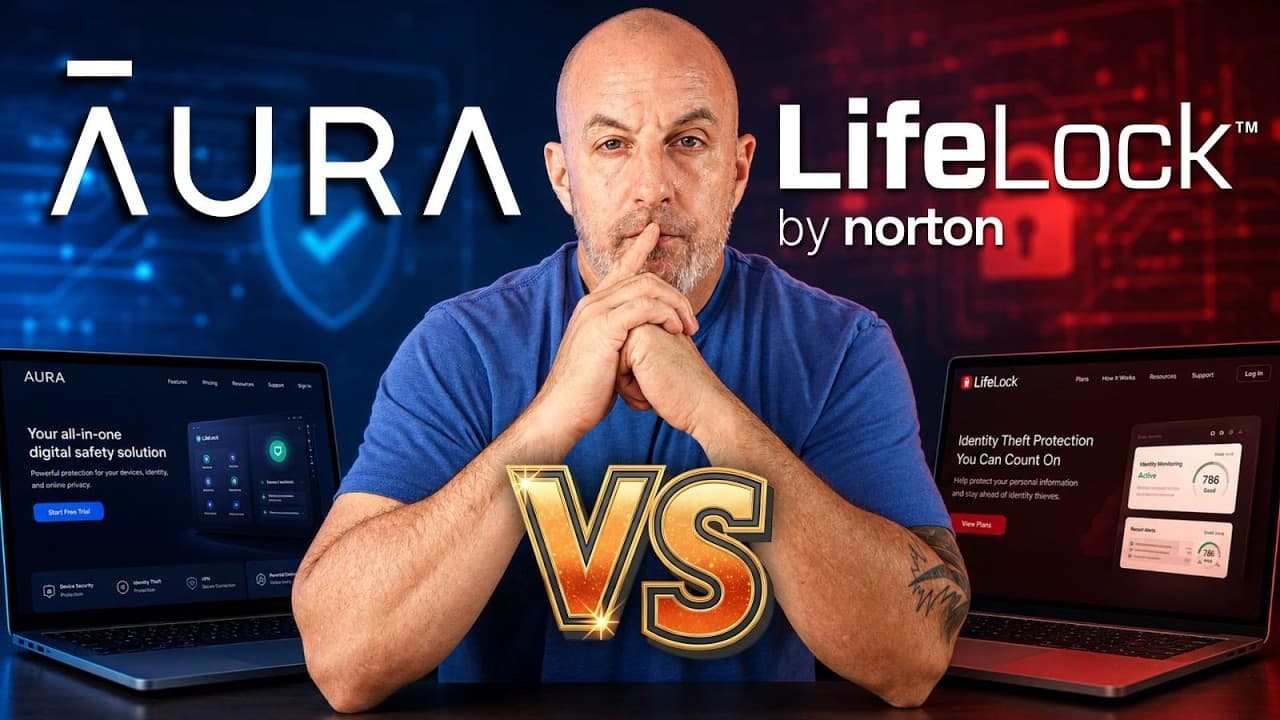
Pick Aura if you want one subscription that covers identity monitoring, device security and family safety at a flat price. Pick LifeLock if your main worry is your money: bank activity, retirement accounts, your home title, and the highest reimbursement limits.
- Aura says it scans the dark web for over 260 types of personal information.
- Every Aura adult plan includes antivirus, a VPN, a password manager, a spam call blocker and three-bureau credit monitoring.
- LifeLock's top Total plan lists up to $1 million each for stolen funds, personal expenses and lawyers and experts, $3 million in total.
- Approximate prices as of the video: Aura about $15, $29 or $50 a month; LifeLock from about $10 to $12 up to about $35 a month, usually higher after year one.
Some of these are partner links; they cost you nothing extra. How we earn
On this page11 sections
Identity theft is no longer just a stolen credit card. Scammers go after Social Security numbers, bank accounts, home titles and even children's details. Aura and LifeLock are two of the biggest names that watch for that kind of misuse, alert you when something looks off, and help you clean up afterwards. They get there in very different ways.
In the video, Consumer Research Studios walks through what each service monitors, what it adds on top, how the plans are priced and who each one suits. This article follows that breakdown. One thing to keep in mind throughout: neither service can stop your information from being stolen in the first place. What you are paying for is monitoring, alerts, data broker removal, recovery help and reimbursement if a covered loss happens.
Quick verdict
For most households, and especially families with kids, Aura is the better pick: one flat-priced plan replaces a separate antivirus, VPN, password manager and parental control app, and every tier gets the same core features. LifeLock wins for people with more complicated finances who want their investments, 401(k) and home title watched, plus the largest reimbursement limits on the Total plan.
Who should skip each one
Skip Aura if you already pay for a good antivirus, VPN and password manager and are happy with them. A large part of Aura's value is the bundle, and you would be paying again for tools you already have. It is also not the one built around finance: the video credits LifeLock, not Aura, with watching retirement accounts, investments and home titles.
Skip LifeLock if price creep bothers you. The video notes that LifeLock usually raises prices after the first year, while Aura keeps pricing flat. The entry Core plan covers basic alerts only, and the features that make LifeLock stand out, like bank alerts, investment and home title monitoring and scam reimbursement, sit on the higher tiers. If you want device protection too, that means bundling Norton 360 rather than getting it included.
What they have in common
Both services monitor the dark web for leaked personal details such as Social Security numbers, driver's license numbers, passwords and email addresses, and alert you when something turns up. Both automatically ask data broker sites to remove your information, which can cut down on spam calls, texts and scam emails. Both watch for unusual financial activity, both include some form of identity theft insurance, and both offer help restoring your identity if it is misused. The video calls both highly rated; the difference is focus, not whether one of them works.
The big split: digital safety net vs financial safety net
Aura treats online security as more than identity theft. Instead of buying separate apps for antivirus, a VPN, a password manager, parental controls and identity tracking, you get all of them in one subscription. At the center is what Aura calls Aura Intelligence, a security engine that, according to Aura, learns your normal patterns and flags things that look like fraud, such as a leaked Social Security number, an unexpected credit check or an odd bank charge.
LifeLock is one of the oldest names in the category and is now part of Gen, the same family of brands as Norton. Its approach is summed up as detect, alert and restore: watch for misuse of your information, tell you quickly, then help you fix it. Where Aura spreads wide across your digital life, LifeLock goes deeper on money and recovery.
Monitoring and data removal
Aura says it scans the dark web for over 260 kinds of personal information, including passports, driver's licenses, bank details and email passwords. It also searches hundreds of data broker sites and sends removal requests for you. Every adult plan adds three-bureau credit monitoring.
LifeLock covers similar ground on the dark web and checks public records, and it also sends data broker removal requests. Its standout is what it calls AI financial defense: it links to your bank accounts, learns how you normally spend, and alerts you to strange withdrawals, charges from unfamiliar merchants or subscriptions you did not sign up for. On higher tiers it also watches your 401(k), investments, home title and SIM swap attempts, where a scammer takes over your phone number to intercept login codes. The video points out that many basic services skip those threats entirely.
Device security and family features
This is where Aura pulls ahead. Every adult plan includes antivirus, a VPN, a password manager and a spam call blocker at no extra charge. The family plan adds parental controls, screen time limits, Social Security number monitoring for kids, and a safe gaming feature powered by Kidas that watches online games for bullying and predatory behavior. The video calls it one of the best family protection bundles available.
LifeLock does not include those tools by default. If you want antivirus, a VPN and cloud backup, you can bundle LifeLock with Norton 360. The video does not cover parental controls for LifeLock, so if those matter to you, Aura is the clearer choice.
Insurance, reimbursement and recovery
LifeLock's reimbursement is the main reason to choose it. According to LifeLock, every plan comes with its Million Dollar Protection Package, with limits that rise by tier. On the top Total plan that means up to $1 million for stolen funds, up to $1 million for personal expenses and up to $1 million for lawyers and experts, $3 million in total. The Advanced and Total plans also include scam reimbursement for certain losses up to $10,000, which matters because many banks will not refund money you were tricked into sending yourself. If your identity is stolen, LifeLock pairs you with a dedicated specialist who handles paperwork and deals with banks and credit bureaus.
Aura's individual plan includes $1 million in insurance, according to the video, and the amount grows with the couple and family plans. The video does not break down Aura's coverage categories or mention scam reimbursement, so check the current terms before you rely on either for a specific kind of loss. Coverage always depends on the policy's conditions.
Pricing and plans
Aura keeps it simple: individual, couple and family plans all get the same core features, and only the number of people and the insurance amount change. LifeLock uses a tiered setup where features unlock as you move up. These are approximate monthly prices as of the video.
| Aura | LifeLock | |
|---|---|---|
| Plan structure | Same features on every plan | Core, Advanced and Total tiers |
| Entry price | About $15/month, one person, $1M insurance | Core, about $10 to $12/month, basic alerts |
| Middle option | Couple, about $29/month | Advanced, adds bank alerts and higher payouts |
| Top option | Family, about $50/month, up to 5 adults and unlimited kids | Total, about $35/month, full credit tracking, investments, home title |
| Price after year one | Flat, per the video | Usually goes up |
| Antivirus and VPN | Included | Via a Norton 360 bundle |
| Parental controls | Included on family plan | Not covered in the video |
| Scam reimbursement | Not mentioned in the video | Up to $10,000 on Advanced and Total |
Prices change often and introductory offers vary, so confirm the current figure at checkout.
Which to pick
- Get Aura if you want one app instead of five, you have kids who game or are online a lot, or you want predictable pricing. It is the easier choice for everyday users and parents.
- Get LifeLock if you have retirement accounts, investments or property you want watched, you want bank-linked spending alerts, and the highest reimbursement limits and scam coverage matter more to you than extra security tools.
- Skip both if you only want credit monitoring and are comfortable freezing your credit yourself; you would be paying for a lot you will not use.
Pros and cons
What works
- Aura: antivirus, VPN, password manager and spam call blocker included on every adult plan.
- Aura: strong family plan with parental controls, kids' SSN monitoring and safe gaming alerts.
- Aura: same features on every tier and flat pricing, per the video.
- LifeLock: bank-linked spending alerts plus 401(k), investment, home title and SIM swap monitoring on higher tiers.
- LifeLock: up to $3 million total coverage on Total and scam reimbursement up to $10,000.
What doesn't
- Aura: you pay for the bundle even if you already have security tools.
- Aura: the video does not mention scam reimbursement.
- LifeLock: prices usually rise after the first year.
- LifeLock: the most useful features sit on the pricier tiers; device security costs extra via Norton 360.
Frequently asked questions
Is Aura or LifeLock better for families?
Aura. Its family plan covers up to five adults and unlimited kids for about $50 a month as of the video, and adds parental controls, screen time limits, kids' Social Security monitoring and safe gaming alerts.
Which one has more insurance coverage?
LifeLock's top Total plan, according to LifeLock, offers up to $1 million each for stolen funds, personal expenses and lawyers and experts, $3 million in total, plus scam reimbursement up to $10,000 on Advanced and Total. Aura's individual plan includes $1 million. Always read the policy terms.
Does LifeLock include antivirus and a VPN?
Not on its own. You can bundle LifeLock with Norton 360 for antivirus, a VPN and cloud backup. Aura includes antivirus and a VPN on every adult plan.
Can Aura or LifeLock prevent identity theft?
No service can guarantee that. Both monitor for leaks and suspicious activity, send alerts, remove your data from broker sites, help with recovery and reimburse certain losses under their policy terms.
Does LifeLock raise its price after the first year?
Usually, according to the video. Aura keeps its pricing flat. Check the renewal price before you sign up.
Both services do the core job of watching for misuse of your information and helping when something goes wrong. The question is what else you want. If you would rather have one subscription that protects your devices and your kids too, choose Aura. If your finances are the thing you most want guarded, and you want the biggest safety net if a loss happens, choose LifeLock.
Filed under
More in Privacy & Security
 ComparisonDashlane vs NordPass: Which Password Manager Should You Use?Dashlane leans into active phishing defense and business controls; NordPass keeps things simple and cheaper, with a free tier, email masking and a built-in authenticator.
 ComparisonCloaked vs Incogni vs DeleteMe: Which Privacy Service to Pick?Cloaked stops your real email and number from spreading, Incogni quietly sends removal requests to hundreds of data brokers, and DeleteMe shows you exactly what it removed.