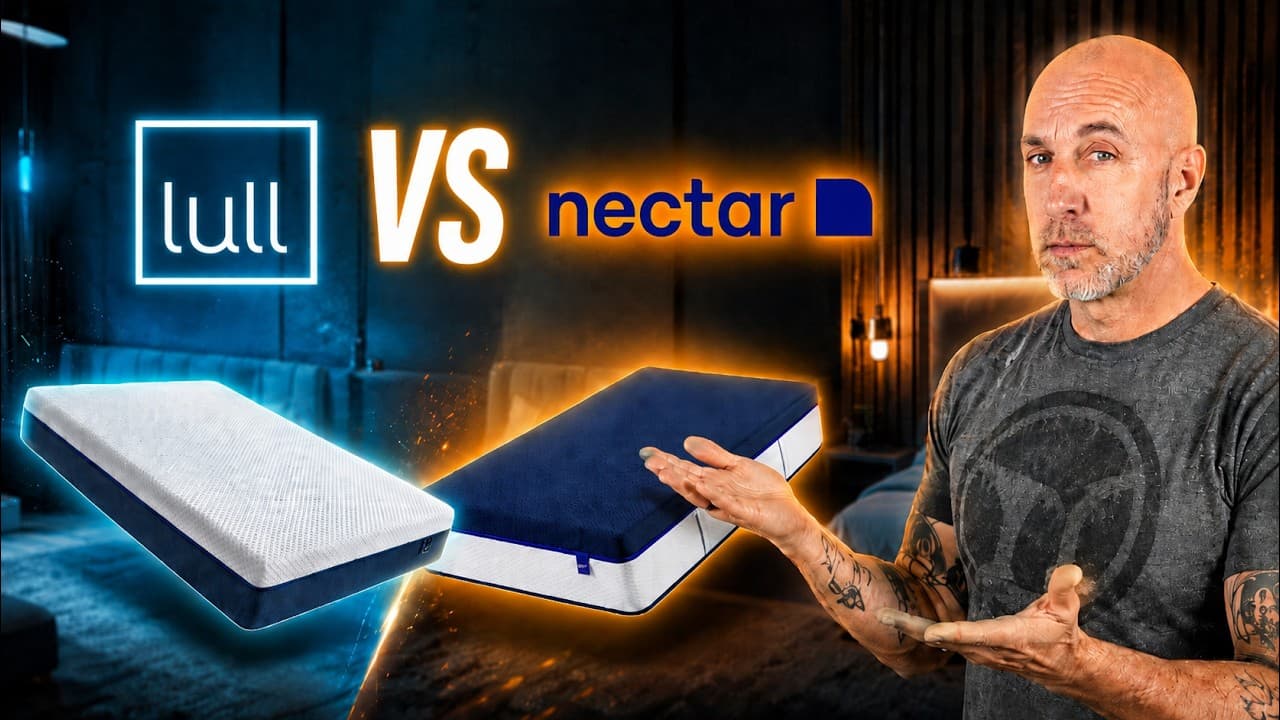
Pick Lull if you sleep on your back or switch positions and want a stable, balanced medium-firm bed that's easy to get used to. Pick Nectar if you sleep on your side, want deep pressure relief and value its Forever warranty.
- Both offer a 365-night trial.
- Lull backs its beds with a limited lifetime warranty; Nectar offers its Forever warranty for as long as you own the mattress.
- Approximate queen prices at the time of the video: Lull Original a little over $700, Nectar Classic around $700.
- Both ship as a bed in a box; Nectar sometimes offers white glove setup and old-mattress removal, depending on location.
- Lull uses CertiPUR-US certified foams with low VOC emissions, according to Lull.
Some of these are partner links; they cost you nothing extra. How we earn
On this page13 sections
Lull and Nectar look almost identical on paper. Both are online, direct-to-consumer foam beds. Both arrive in a box. Both give you a full year to test, and the queens cost within a few dollars of each other. So if you're stuck choosing, the spec sheet won't help much.
What does separate them is the feel when you lie down, and a few differences in delivery and warranty. In this comparison we go through materials, comfort, cooling, delivery, trials, warranties and price, then say which bed suits which sleeper. We have affiliate links for both, so there's no reason for us to favour either one.
Quick verdict
There's no single winner, because these beds are built for different sleepers. Lull is the pick for back sleepers, combination sleepers and anyone who wants a no-fuss, balanced bed. Nectar is the pick for side sleepers who want deeper contouring, and for buyers who want the strongest long-term protection, thanks to its Forever warranty.
The two companies
Lull built its name on making good sleep products more affordable by selling direct. Skipping the crowded mattress store lets it keep prices competitive. It also puts weight on materials: according to Lull, its foams are CertiPUR-US certified and kept low in VOC emissions, which should help with the new-mattress smell many buyers worry about. Its lineup is deliberately simple.
Nectar has become one of the most recognisable names in online mattresses by combining affordable pricing with generous policies. Its big draw is removing risk for first-time online buyers, with one of the longest trials around and a well-known lifetime warranty.
Put simply, both sell direct, but Nectar leans harder on customer protection, while Lull leans on simplicity and practical design.
What they have in common
- Foam beds sold online, without a store markup.
- Bed-in-a-box delivery: compressed, rolled and dropped at your door.
- Cooling-focused foams designed to avoid the stuffy feel of older memory foam.
- A 365-night trial, long enough to sleep through every season.
- Lifetime-style warranties against defects.
- Similar queen prices, around $700 at the time of the video.
If you're mostly worried about overpaying or getting stuck with a bed you don't like, either one solves that. The decision comes down to feel.
Comfort and feel: the real difference
Lull leans balanced medium-firm. Its design mixes pressure relief with solid support, and the foam layers gently contour around pressure points while keeping your spine in a straight line. That suits back sleepers, people who switch positions through the night, and anyone who wants a stable bed that isn't rock hard. One thing we like about Lull is that the feel is easy to adapt to. It doesn't take a love-it-or-hate-it approach, so most people settle in after the first night or two.
Nectar goes for classic memory foam. Traditionally its beds have that deeper, gentle sinking hug people picture when they think of memory foam. You get more contouring around the shoulders, hips and other pressure points, which helps side sleepers and anyone who builds up pressure during the night.
The simple rule: if you love the feeling of a bed moulding to your shape, Nectar has the edge. If you'd rather lie more on top of the bed, with some contouring and more push-back support, Lull is likely the better fit.
Cooling
Both brands have put real work into cooling, and they take similar paths.
Lull uses gel-infused memory foam with an open-cell structure. The gel is meant to draw heat away from your body, while the open cells give air more room to move instead of getting trapped.
Nectar uses breathable covers made from polyblend fabrics, often including Tencel, designed to wick moisture and heat away from your skin. Underneath, its own cooling memory foam layers help dissipate heat.
For most people, both do a good job of keeping memory foam from feeling overheated, and one may feel slightly cooler than the other depending on your own body heat. Cooling probably shouldn't be the reason you pick one over the other.
Delivery and setup
With Lull, the mattress arrives compressed and rolled in a surprisingly compact box. You drag it to the bedroom, cut away the plastic and let it expand to full size over the next day or so. No heavy lifting beyond moving the box.
Nectar ships most of its lineup the same way, but it has an advantage if you want a hands-off experience: a white glove service you can sometimes add, where professionals set the bed up where you want it and take your old mattress away. The catch is availability. It isn't offered everywhere and can be tricky to add depending on where you live and what you order, so check at checkout before counting on it.
Trials and warranties
Lull offers a 365-night trial, so you can test the bed for a full year. If it isn't right, Lull handles the return and pickup. Its beds carry a limited lifetime warranty against defects.
Nectar also offers 365 nights, and stands out with its Forever warranty, one of the best-known programmes in the industry. Nectar promises to repair or replace your mattress if a defect appears, for as long as you own it.
Both give excellent protection. Nectar gets a slight edge here because of the reputation of its Forever programme, which gives many buyers extra confidence.
Lull vs Nectar at a glance
| Lull | Nectar | |
|---|---|---|
| Feel | Balanced medium-firm, more on top of the bed | Deeper memory foam hug |
| Best for | Back and combination sleepers | Side sleepers and pressure relief |
| Cooling | Gel-infused, open-cell memory foam | Breathable polyblend cover, often with Tencel, plus cooling foam |
| Materials note | CertiPUR-US foams, low VOC (per Lull) | Not covered in our video |
| Delivery | Bed in a box | Bed in a box; white glove sometimes available |
| Trial | 365 nights, return pickup handled | 365 nights |
| Warranty | Limited lifetime | Forever warranty |
| Queen price (approx.) | Lull Original, a little over $700 | Nectar Classic, around $700 |
Prices are approximate and as of the video; both brands change them often.
Price and value
At the time of the video, the Lull Original queen was a little over $700, though it varies by where you shop. Lull keeps its lineup small and cuts out extras, which helps hold the price down while still using quality materials. That's why it's popular with first-time buyers, young professionals furnishing a first place, and people buying a good bed for a guest room.
The Nectar Classic queen usually landed around $700. Nectar's value comes from the bundle: the year-long trial, the Forever warranty, and frequent promotions that throw in free pillows or bedding sets.
Prices move with sales, so compare on the day you buy. Either way, both cost far less than a comparable bed on a showroom floor.
Who should skip each one
Skip Lull if you're a dedicated side sleeper who wants to sink in, or you love the slow, body-moulding feel of traditional memory foam. Lull's balanced design is deliberately more supportive than that.
Skip Nectar if you're a back or stomach sleeper who wants to stay on top of the bed, or you dislike the stuck-in feeling some memory foam gives. Also don't plan around white glove delivery until you've confirmed it's available at your address.
One gap to know about: our video didn't cover edge support or motion isolation for either bed, so we can't compare them on those points.
Which to pick
- Get Lull if you want a no-fuss mattress with a balanced mix of comfort, support and affordability. It's easy to set up and its middle-of-the-road feel suits almost anyone, especially back and combination sleepers.
- Get Nectar if you put deep pressure relief and long-term peace of mind first. Its year-long trial and Forever warranty make the purchase feel close to risk-free, and its deeper hug suits side sleepers.
Both are good beds. It comes down to whether you prefer Lull's simple, balanced approach or Nectar's deeper, body-hugging feel and long-term coverage.
Pros and cons
What works
- Lull: balanced medium-firm feel that most people adapt to in a night or two.
- Lull: CertiPUR-US foams with low VOC emissions, per Lull.
- Nectar: deep contouring for side sleepers.
- Nectar: Forever warranty and frequent free-bedding promotions.
- Both: 365-night trials and queens around $700.
What doesn't
- Lull: not the sinking memory foam hug some side sleepers want.
- Nectar: deeper sink may not suit back or stomach sleepers.
- Nectar: white glove delivery isn't available everywhere.
Frequently asked questions
Is Lull or Nectar better for side sleepers?
Nectar, in most cases. Its classic memory foam feel gives more contouring around the shoulders and hips, which helps relieve pressure for side sleepers.
Is Lull or Nectar firmer?
Lull leans balanced medium-firm, with more push-back support. Nectar has a softer, deeper sinking feel.
Which has the better warranty?
Both are strong. Lull offers a limited lifetime warranty; Nectar's Forever warranty promises repair or replacement for defects for as long as you own the bed, and has the stronger reputation.
How much do Lull and Nectar cost?
At the time of the video, a Lull Original queen was a little over $700 and a Nectar Classic queen around $700. Prices change with sales, so check before buying.
Which sleeps cooler?
They're close. Lull uses gel-infused open-cell foam; Nectar uses a breathable cover and cooling foam. For most people cooling won't decide it.
Filed under
More in Mattress Reviews
 ReviewSaatva Review: What the Extra Money Actually BuysThe Saatva Classic tests among the best mattresses anywhere on day one. We itemize what the premium buys, where the year-two complaints cluster, and how to buy it safely.
 ComparisonSaatva vs Sealy: Online Luxury Bed or Try-It-in-Store Classic?We slept on both. Sealy lets you lie down in a store today at almost any budget; Saatva gives you a full year to test, a lifetime warranty and free setup.
 ReviewHelix Midnight Luxe Review: Does It Earn the 'Best Mattress' Title?We slept on the Helix Midnight Luxe for weeks and checked lab measurements: pressure relief, motion isolation, cooling, edge support, the bounce trade-off, and price.
 ComparisonHelix Kids vs DreamCloud: Which Mattress Should You Buy?We compared the Helix Kids and DreamCloud's hybrid on the same lab measurements, plus trials, warranties and real prices. The answer depends on who's sleeping on it.